
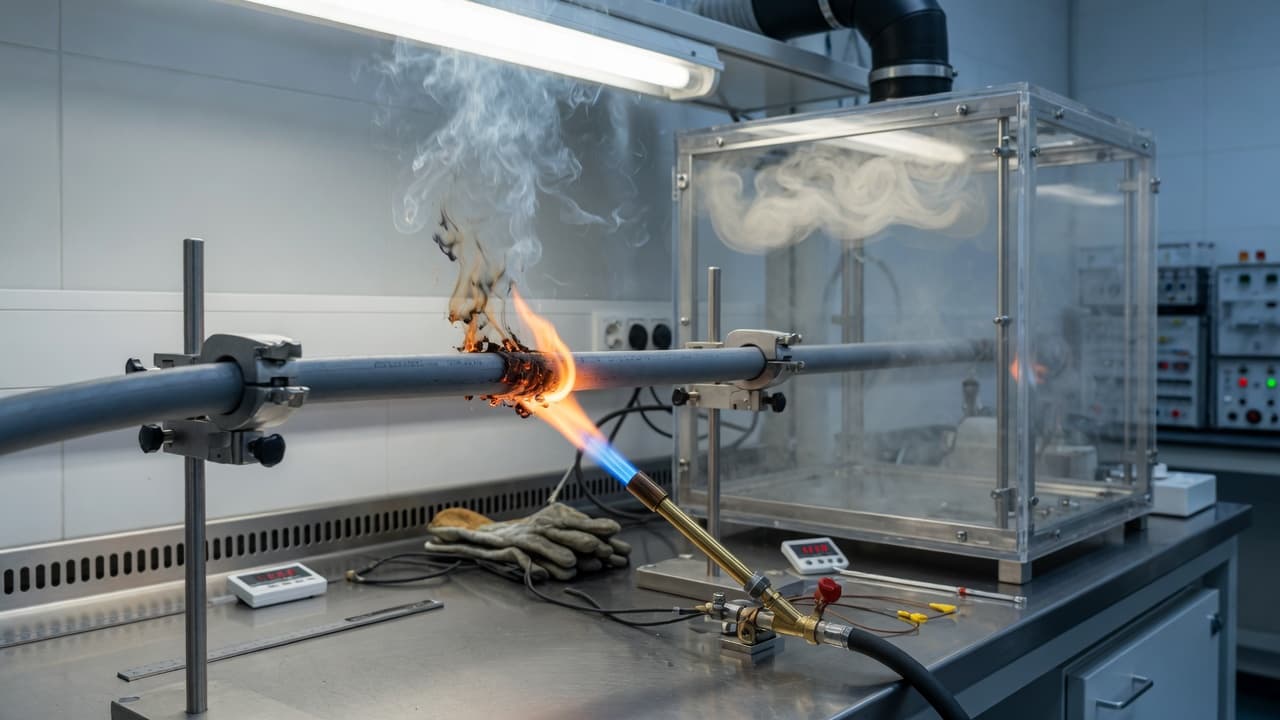
Exporting LSZH cable means proving performance under standardized fire scenarios, not just internal factory checks. Two tests appear on almost every buyer specification sheet: IEC 61034 for smoke density and IEC 60332 for flame propagation along the cable bundle.
Both tests punish poor filler dispersion. When ATH or MDH agglomerates inside the compound, smoke generation spikes and char formation becomes uneven — even if the nominal filler loading looks correct on paper. The cable may pass a quick bench burn but fail a full IEC panel evaluation.
A well-matched PE-g-MAH grade attacks the root cause at the filler–matrix interface. Sufficient grafting rate ensures hydroxyl sites on ATH/MDH particles are occupied, which reduces smoke-releasing volatiles during pyrolysis and produces a more coherent char layer. At the same time, the polyethylene backbone maintains compatibility with the EVA or LLDPE matrix used in most LSZH recipes, so elongation at break does not collapse when filler loading climbs toward 60%.
Practical guidance from Shengde's compounding support: start compatibilizer addition at 3–5 phr for a 55% ATH formulation, then adjust MFI to match extruder screw speed. Small shifts in grafting rate often move smoke results more than adding another 2% filler ever will.